
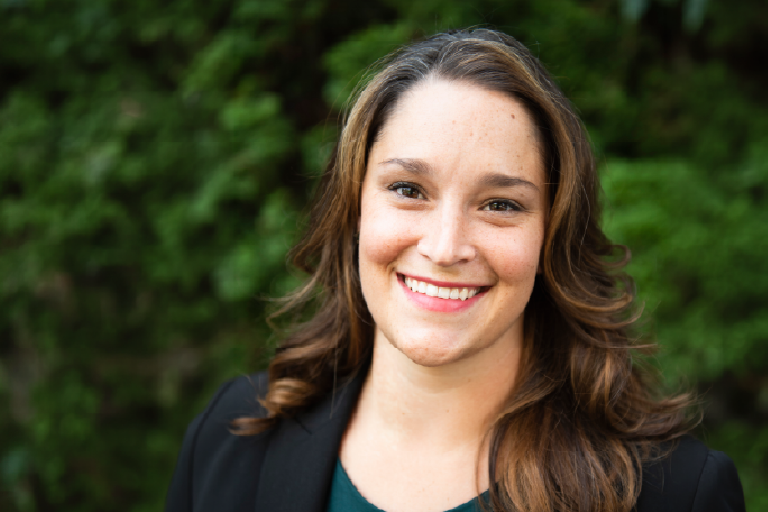
Alexandra Benitez Gonzalez is a doctoral candidate specializing in the field of science communication in the Department of Advertising and Public Relations at Michigan State University’s College of Communication Arts and Sciences.
Her background in environmental science and a master’s degree in Fisheries and Wildlife sparked a deeper interest in how people perceive environmental risks and develop trust in scientists and institutions. This curiosity led her to science communication, where she explores how people’s beliefs about scientists shape trust and trust-related behaviors, how scientists strategically communicate their work, and how alternative ways of knowing can deepen and expand traditional theories of trust.
Building on research that identifies ability, benevolence, and integrity as key dimensions of perceived trustworthiness, her work explores how the role of shared values influences how individuals evaluate scientists and scientific institutions. Benitez Gonzalez is particularly interested in how cultural identity and lived experiences influence perceptions of scientists and trust toward scientists. Her dissertation, “What Makes Scientists Trustworthy? Exploring the Role of Trust Toward Scientists in Puerto Rico”, examines these dynamics among Puerto Rican communities.
Her research has been published in journals including Risk Analysis, Journal of Contemporary Water Research and Education, Current Opinion in Psychology, and Journal of Science Communication. Her scholarship has also been presented at major conferences, including the International Communication Association, Association for Education in Journalism and Mass Communication, and Public Communication of Science and Technology.
What are your research interests? What are some of the current projects you are working on?
My research interests focus on how people, particularly individuals from underrepresented STEM backgrounds, perceive scientists, understand scientific risks, and develop trust in science. More recently, I have focused on Hispanic and Latino communities, exploring how cultural and linguistic contexts shape la confianza (trust) in scientists and how research approaches can better capture these communities’ perspectives. This includes developing Spanish-language approaches to measuring trust in scientists and exploring methods less commonly used in science communication, such as testimonios, to better capture lived experiences and inform more culturally responsive communication practices.
Currently, I am developing two collaborative projects. One examines graduate students’ experiences with Public Engagement with Science across Long-Term Ecological Research sites in the United States, with a focus on how institutional culture and expectations shape their engagement. The other explores how interviews with early-career researchers in the African Future Research Leadership Program informed the development of a science communication training series tailored to their audiences, goals, and institutional contexts.
What drew you to ComArtSci?
I first discovered ComArtSci while taking a risk communication course with Bree Holtz, professor in the Department of Advertising and Public Relations, as a master’s student. That experience opened my eyes to the possibility of approaching scientific questions through the lens of communication. Coming from a background in environmental science, fisheries and wildlife, I was drawn to ComArtSci because it allowed me to build on my scientific training while exploring how scientists communicate, how communication strategies are shaped by institutions and goals, and how those efforts are perceived by the people they seek to reach.
Through ComArtSci and the Information and Media Ph.D. program, I have developed a stronger foundation in communication theory and learned to question the assumptions, methodologies, and ways of knowing that shape my research. This experience has encouraged me to think beyond the boundaries of my scientific training and become the kind of scholar I aspire to be, one who is theoretically grounded, methodologically thoughtful, and attentive to whose perspectives are represented in research. My experience here has challenged me to not only ask what we know, but also how we know it and whose perspectives are represented in that knowledge.
Working with John Besley, Ellis N. Brandt professor of public relations in the Department of Advertising and Public Relations, has been an important part of that growth. His mentorship has helped me recognize the importance of goal-driven communication, think more strategically about how scientists communicate their work, and appreciate the critical distinction when researching trust and perceptions of trustworthiness in research. More broadly, his guidance has encouraged me to challenge my assumptions, think critically and sit with complex questions rather than rush toward simple answers. These lessons have shaped not only how I approach my research, but also how I see myself as a scholar and future mentor.
What are your future plans?
My immediate goal is to complete my dissertation and continue developing my current research projects for publication. I hope to expand my work on trust in scientists, particularly among Hispanic and Latino communities, while continuing to explore culturally and linguistically responsive approaches to understanding how people perceive and engage with science.
In the long term, I hope to pursue a career that allows me to bring together research, teaching, and practice in science communication. I want my work to bridge research and practice by advancing our understanding of trust, risk perception, and science communication while developing meaningful ways for researchers and practitioners to engage diverse communities.
Ultimately, I hope to contribute to a science communication field that is more strategically driven and culturally responsive, one that recognizes that effective communication begins not simply with knowing the science, but with understanding what we hope people will do, what they believe and feel, and the lived experiences and perspectives they bring to the conversation.
6) Soundbyte from Advisor:
“It's been great to work with Alex over the last few years to work through the challenge of how to help scientists demonstrate genuine trustworthiness. Her efforts can have a lot of impact.” -- John Besley, Ellis N. Brandt Professor of public relations in the Department of Advertising and Public Relations