

Undergraduate researchers in College of Communication Arts and Sciences showcased work exploring timely questions around media, identity, technology and health at this year’s University Undergraduate Research and Arts Forum (UURAF), highlighting the strength of student research and faculty mentorship.
Held at the Breslin Center, UURAF brought together more than 1,300 students presenting over 900 research and creative projects across Michigan State University. For ComArtSci, the event highlighted the breadth of student research and the faculty mentorship that supports it.
Undergraduate research is a core part of experiential learning in ComArtSci, providing students the opportunity to apply classroom knowledge to real-world questions.
“Through that work, students learn the creative and research process by actively doing the work of the discipline,” said Kari Schueller Lopez, associate dean for undergraduate education. “That engagement builds confidence and helps them see themselves as contributors in their field.”
Across this year’s projects, students examined themes such as digital media, identity and the social impact of communication technologies.
“Across ComArtSci, student work spans creative practice, applied projects and traditional research,” Schueller Lopez said. “That range is one of our strengths. Students are producing documentaries, examining communication and health, exploring journalism, studying media and technology, and asking questions that matter in their fields.”
Exploring belonging through algorithms
Among the projects presented, students working through a Department of Communication course examined how social media algorithms may shape identity and belonging through short-form video content.
The project, Algorithmic Reflection on Group Identity: Short-Form Content as It Relates to Belonging, explored how exposure to curated content similar to TikTok feeds influences how individuals relate to identity groups.
“All three of us were very interested in how different identities are formed and grouped under social media’s algorithms,” said Ada Tussing, a sophomore and member of the research team. “We were looking at phenomena like echo chambers and how communities can find belonging in online spaces.”
The team asked participants to self-identify as introverted or extroverted, then exposed them to curated video content that either aligned with or challenged those identities, measuring their sense of belonging before and after.
The findings revealed a more complex picture than expected.
“We found that participants’ identity strength actually decreased overall after viewing the videos,” Tussing said. “It showed us how complicated and nuanced these interactions with content really are.”
The project was developed through an honors seminar that allows students to design and conduct their own research.
“Studying something that feels so natural to my generation, like scrolling on my phone, made this an especially meaningful experience,” Tussing said.
She said the experience strengthened her critical thinking.
“There are so many moving pieces and so many conclusions you have to be careful not to jump to,” she said.
The role of mentorship
Central to that experience is faculty mentorship, which guides students through the research process while encouraging independence.
The project was mentored by Allison Eden, professor in the Department of Communication, who worked with the group over two semesters.
“Research is fundamentally a process of being curious and figuring out the best way to ask questions and get answers about the world,” Eden said.
“They really guided the project based on their own experiences,” she said. “I supported them with refining their measures, building the survey and analyzing the data.”
For Tussing, that support made a lasting impact.
“She was always available to help us brainstorm and think through the process,” she said.
Showcasing student work
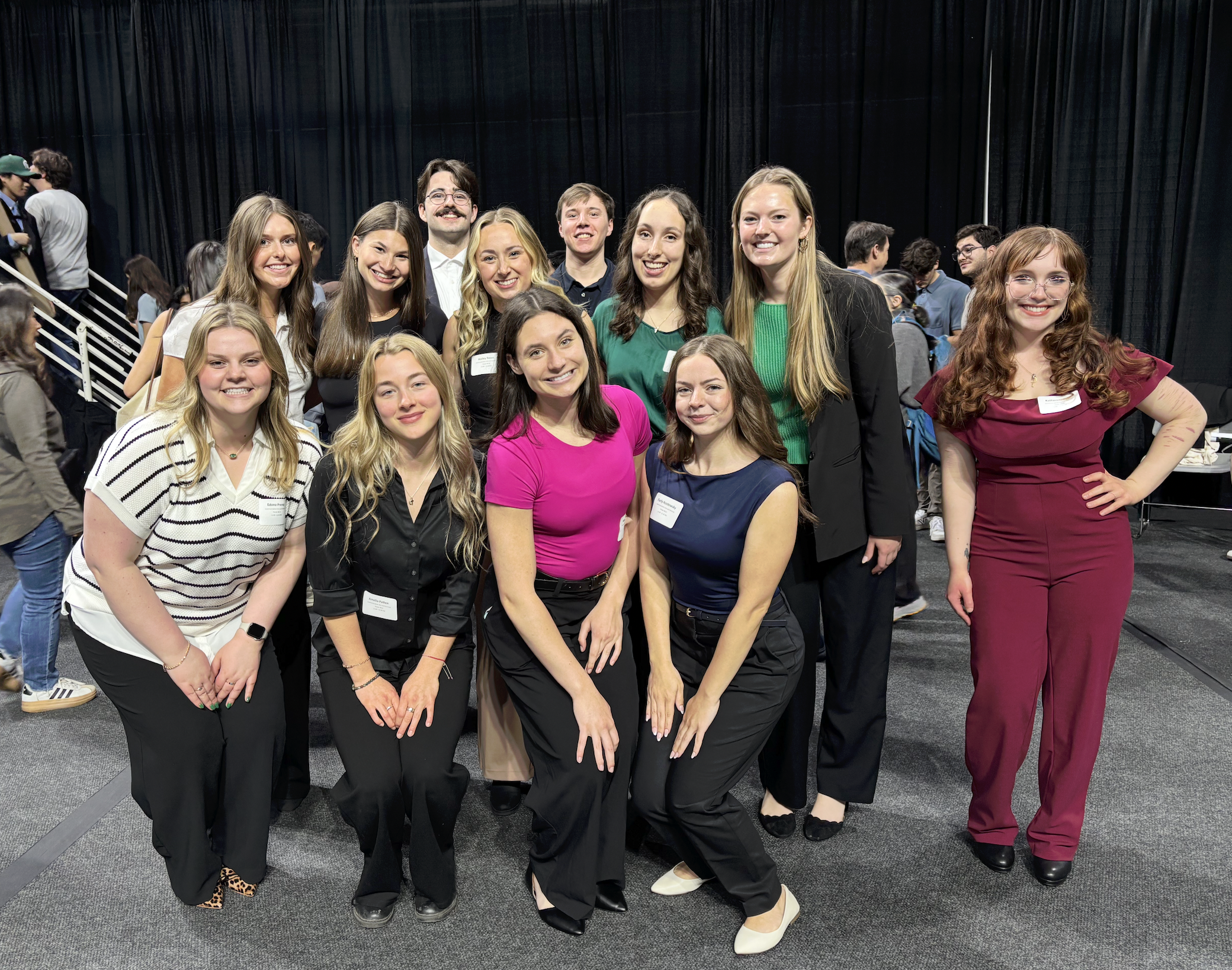
Events like UURAF give students the opportunity to present their work and engage with new audiences.
“Participation in UURAF creates a space where the depth and range of what our students are doing is on full display,” Schueller Lopez said.
For ComArtSci, the event also serves as a point of pride — highlighting both student achievement and the mentorship behind it.
“The professionalism and confidence our students demonstrate reflects the impact of our faculty, our curriculum and the opportunities we are creating for them,” she said.
Recognizing excellence
The college’s strong showing at UURAF extended beyond presentations. At the UURAF Awards Ceremony, Bridget Walsh, professor in the Department of Communicative Sciences and Disorders, was named MSU’s Undergraduate Research Mentor of the Year, recognizing her outstanding commitment to supporting student researchers.
ComArtSci undergraduate researchers also earned nine first-place awards at UURAF across five projects from the School of Journalism and the Department of Communicative Sciences and Disorders, reflecting both the depth of student research and the faculty mentorship that supports it.
By Claire Dippel