
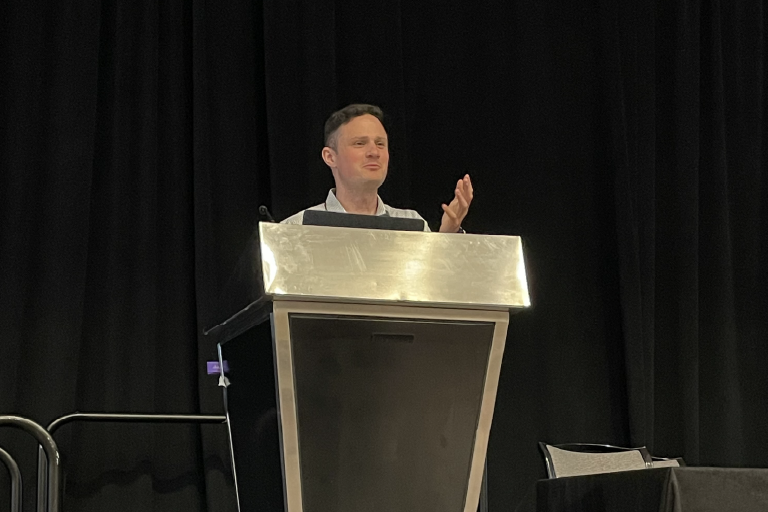
One of the core interests of David M. Markowitz, Red Cedar Distinguished Professor in the Department of Communication at Michigan State University, is to understand the social and psychological meaning underneath language patterns. For example, Markowitz has used computational techniques to evaluate how people communicate falsely versus truthfully, how words reveal persuasion processes in settings like pet adoption, and how basic human values are represented over the lifespan in millions of obituaries.
How does a researcher take millions of words and analyze them as data?
The simple answer is that scholars have computers count words for them. Large-scale natural language processing models are used to make psychological inferences from human text. But now, with artificial intelligence (AI) serving as a communicator in everyday interactions, it has become important to also evaluate how humans and AI communicate differently. Human-AI communication and the role of AI in human-human connection, have become a massive interest in the social sciences with Markowitz as a leader in this space.
Studying human-AI connections is difficult because few tools are built for it. This is why Markowitz created Dyadic, a fully integrated platform for running live conversation studies between humans or between humans and AI. Participants can have live text or audio chats with other humans and non-humans, helping to facilitate deeper study into how relationships develop over time — and are revealed in language — with various communicators.
As AI takes on more of the conversational work once reserved for people, what words reveal about honesty and connection has genuine stakes for thinking about how to build technology and trust others through it. Bridging communication, social psychology and computation, Markowitz’s work reflects the interdisciplinary spirit of ComArtSci.
For more information about David Markowitz and his work, please click here.