
The Leaders Invested in Fostering Trust (LIFT) Project has released a new report examining how Indiana residents engage with media, where they place their trust for information and what issues matter most to their communities.
The report, funded through a generous grant from the Lumina Foundation awarded in 2024, expands the project’s ongoing research into more Midwestern communities. The project previously focused on Michigan and Minnesota.
“The News for Hoosiers: Community Priorities and Media Preferences Report” was developed by Danielle K. Brown, the 1855 Professor of Community and Urban Journalism and an associate professor in the School of Journalism, Jarrad Henderson, artist in residence for the School of Journalism and graduate research assistants Jasmine Snow and Jung-Hsiang (Eric) Hsieh.
To support the project’s mission of fostering a more inclusive journalism industry and news information ecosystem — particularly for communities underserved by traditional journalism — the team surveyed and interviewed more than 2,200 Indiana residents. The research examined media habits, community concerns, and perceptions of local news and information sources.
“Indiana is the first ‘red’ state we’ve studied, and it is the first time we’ve zoomed out to look at the statewide population at this depth,” said Snow, a master’s student in journalism who is expected to graduate in 2026. Snow has worked with the LIFT Project since 2022 and became the lead graduate research assistant in 2024.
“We were able to study general community patterns, as well as those in marginalized communities,” she said. “Because of the depth and breadth of our report — especially in conjunction with our Minnesota and Michigan reports — it can help us understand more about Midwestern information ecosystems across different geographic and political environments.”
The report highlights several trends related to news consumption, media engagement and community concerns, including who residents trust to deliver information.
The team found that many residents expressed distrust in news media, reflecting broader national trends. However, the report illustrated that trusted information providers had surprising differences. For some, shared identity markers and political affiliation influenced who people trusted for information. For others, trust was simply about the subject.
“We also found it very surprising that so much trust was placed in weather apps and weathercasters,” Brown said, reflecting on the science-based and predictive reporting typical of this genre. “We think weathercasters may teach us a lot about building pathways of trust between communities and newsrooms.”
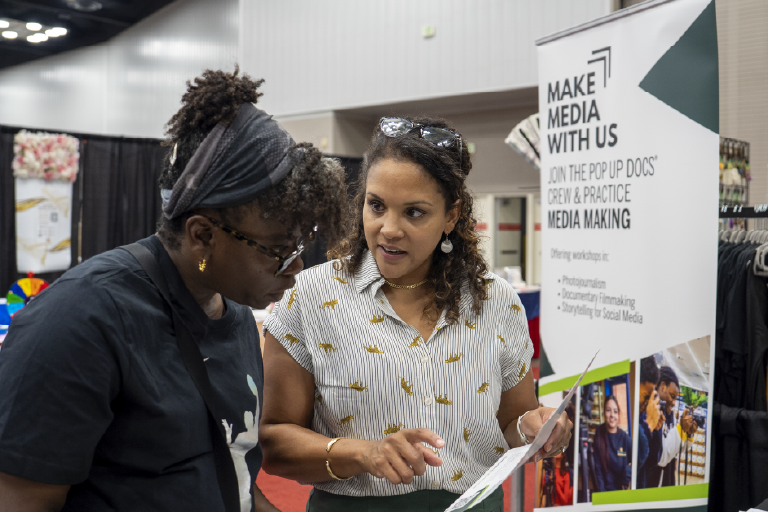
Brown, who founded the LIFT Project in 2021 in Minneapolis, Minnesota, said the team’s next phase of research will focus on auditing news coverage of key events in Indiana and documenting trusted messenger perspectives. This summer, Henderson will lead engagement work with community members interested in becoming trusted messengers and media makers in local communities. The project prioritizes community-driven inquiries and graduate student involvement, so that research like this makes it back into the community.
“I believe the report presents findings that can not only be useful to practitioners but also inspire academically meaningful research projects, especially the observed phenomenon of people’s generally negative experiences with journalists,” said Hsieh, a first-year doctoral student in the School of Journalism.
After spending nearly a year working on the report, Snow said she is excited to continue contributing to the LIFT Project’s research efforts.
“I’ve been with LIFT for a long time. To see the project continuously expanding, adapting and finding ways to serve communities is so amazing,” she said. “Showing up for people — especially those in marginalized and rural communities — is why I got into journalism in the first place.”
Readers can access the full report here.
By Casey Halas