
What happens when the tools researchers use begin changing as quickly as the communication they are trying to understand?
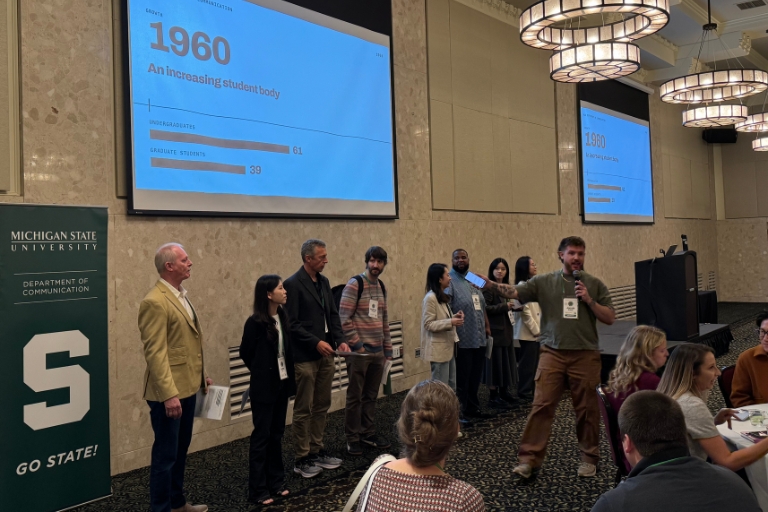
That question surfaced throughout Communication Science Futures, a conference hosted by Michigan State University's Department of Communication Sept. 18-20. Scholars from across the communication discipline gathered at MSU to examine where the field is headed, from artificial intelligence and emerging research methods to the theories used to explain human behavior.
Across a weekend focused on the future of communication research, theory and methods, a common theme emerged: embracing what new technologies make possible while continuing to question their limits. As the ways people communicate and the tools researchers use to study them evolve, scholars are considering what needs to change alongside them and what still holds true.
Creating space for unanswered questions
Unlike traditional academic conferences that primarily showcase completed research, Communication Science Futures places collaboration and problem-solving at the center of its programming. Alongside presentations and research posters, participants joined more than 18 small-group discussions designed to tackle questions and challenges facing the field.
"The things researchers most need to talk through are the things that don't make it into finished papers or conference presentations," said Jacob Fisher, associate professor in the Department of Communication and an organizer of the conference.
Those conversations included everything from how artificial intelligence is changing research practices to whether existing communication theories adequately explain emerging technologies and social behaviors.
For Ralf Schmälzle, associate professor in the Department of Communication, that meant leading a discussion about whether AI agents should be considered colleagues, tools or crutches in the research process. While these technologies can make complex analyses more efficient, they also raise questions about researchers' ability to understand and verify the work being done.
"If you're the researcher, you need enough expertise to 'ride' and 'steer' the tool, rather than the other way around," Schmälzle said.
The discussion reflects the conference's larger purpose: creating opportunities for researchers to examine emerging challenges together rather than simply presenting their findings.
Connecting ideas across disciplines
Another recurring theme was the need to revisit and strengthen communication theories, particularly when researchers studying similar experiences use different terminology or approaches.
Elizabeth Dorrance Hall, associate professor in the Department of Communication, brought that challenge to the conference through her work on marginalizing communication, or messages and interactions that make people feel excluded, dismissed or as though they don't belong.
Her research brings together perspectives from different disciplines to better understand why people send these messages, how others interpret them and how communication can help foster belonging.
"Communication theory is maybe more important than ever before," Dorrance Hall said. "Theory helps us explain patterns we see in the 'real world' so that we can study them, predict them, and ultimately better understand what it means to be a communicator in our current environment."
For Fisher, discussions about AI and theory revealed a shared challenge: determining whether changing communication environments require entirely new explanations of human behavior or more rigorous testing of existing ones.
Participants also examined how researchers measure experiences such as social support, memory and online hate, including whose perspectives are considered when evaluating communication.
Turning conversations into collaboration
The conference's discussion-centered approach also helped turn unresolved research questions into potential collaborations.

At one table, a doctoral student presented a dissertation project examining online hate. Through discussion, the group developed a possible study design comparing how people targeted by hateful messages and those who witness them interpret the same communication.
Other groups identified opportunities to develop shared approaches to studying memory, create publication opportunities for studies that replicate previous findings or produce inconclusive results, and share datasets across research teams.
These exchanges illustrate what makes Communication Science Futures distinctive. Rather than expecting researchers to arrive with all the answers, the conference encourages them to identify challenges, learn from one another and build connections that can move the field forward.
For Fisher, the goal is for participants to leave with new ideas, collaborators and a recognition that the challenges they face are often shared across the discipline.
As communication continues to evolve, the future of the field may depend not only on developing new technologies or theories, but also on creating opportunities for scholars to question, test and strengthen them together.
By Claire Dippel