
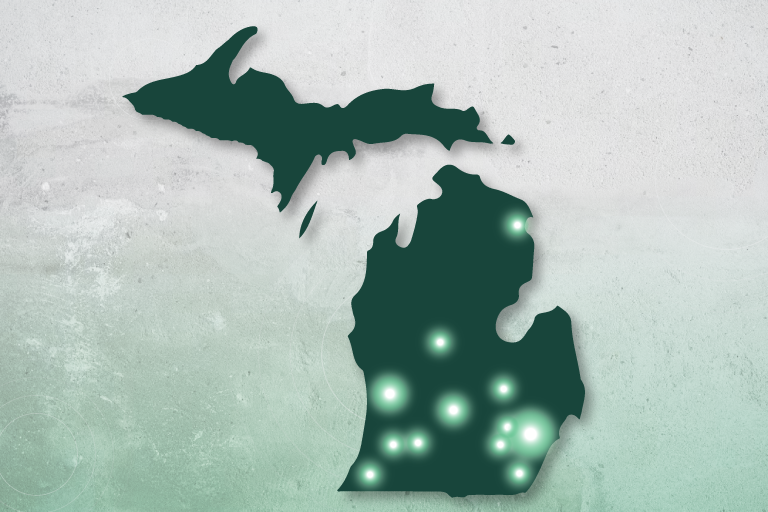
As proposals for data centers and other large-scale digital infrastructure projects become more common across Michigan, many local leaders are finding themselves faced with difficult questions they have never had to answer before.
How should communities prepare for the possibility of a data center? What information can local leaders trust? And how can they engage residents before decisions are made?
For many Michigan communities, especially those without dedicated planning staff or technical expertise, finding reliable answers can be a challenge.
Jean Hardy, associate professor in the Department of Media & Information saw communities struggling to answer those questions long before most people realized how quickly they would become common. As a researcher who studies digital infrastructure and its impacts on communities, Hardy saw an opportunity to bridge the gap between emerging technologies and the local leaders responsible for making decisions about them.
In late 2025, Hardy noticed growing public concern surrounding data center development as communities across Michigan grappled with increasingly contentious conversations. Many local officials found themselves caught between residents concerned about the impacts of proposed developments and land use regulations that limited how communities could respond.
"What I quickly realized was that this was a much larger issue," Hardy said. "These were communities that had never dealt with controversies of this scale and often weren't equipped with the resources to navigate them."
What began as conversations with organizations supporting local governments—including Michigan State University Extension, the Michigan Association of Regions and the Michigan Township Association—has grown into a statewide effort to help communities make informed decisions through trusted, research-based resources.
Much of that work is taking shape through the Quello Center's Emerging Digital Infrastructures initiative, which develops research, educational resources and practical tools to help communities prepare for emerging forms of digital infrastructure.
One of those resources is a five-question self-assessment called How Likely is a Data Center Developer Interested in My Community? Designed for Michigan local governments, the tool provides local officials with a practical "temperature check" to help determine whether data center planning should be an immediate priority. Instead of assuming every community faces the same level of risk or opportunity, the assessment helps local leaders determine whether data center development is a realistic near-term consideration before dedicating significant planning resources. Rather than fueling unnecessary concern, the tool allows communities to focus their time and resources where they're needed most.
"Part of a lot of the work I do with communities is less about preparing them for data center development than lowering the temperature," Hardy said. "A lot of them don't actually need to worry about data center development. It's about talking them through these things, how they happen, what's required and offering a frank evaluation of their community."
Developing practical, trusted resources requires expertise from many different perspectives. Earlier this year, Hardy convened the Michigan Data Center Planning and Development Working Group, bringing together experts from more than 45 organizations across the state. The working group includes representatives from public utilities, state agencies, regional planning organizations, economic development groups, labor unions, internet service providers, local elected officials, community advocates and industry professionals.
Rather than advocating for or against data center development, the working group serves as a neutral forum where experts with differing perspectives share knowledge and help develop resources that communities across Michigan can use.
For Hardy, the work extends far beyond campus.
He regularly meets with planning commissions, community organizations and local officials across Michigan to answer questions, share research and help communities navigate issues ranging from zoning and land use to public engagement.
Hardy says maintaining a strategically neutral approach is essential because communities are often surrounded by competing interests.
"Large utilities and economic development organizations are going to lean in favor of data centers because they benefit from the investment," Hardy said. "Community activist groups are often going to be completely opposed. I'm trying to occupy a ground in between these positions to do some real, on-the-ground problem solving."
While much of the current work centers on data centers, Hardy views the initiative as preparing communities for a much broader range of infrastructure challenges.
As artificial intelligence, digital infrastructure and emerging technologies continue to evolve, communities will increasingly face decisions that require balancing economic opportunity, environmental considerations and local priorities. Hardy hopes to build a robust collection of publicly available resources that communities can use to navigate those decisions with confidence.
Beyond that, he hopes the initiative encourages a broader culture of planning and meaningful community engagement.
"I'd like to help community leaders better prepare themselves for engaging with their communities in a more systematic way around meaningful and often controversial issues," Hardy said. "Rather than assuming what communities want or simply listening to the loudest voices in the room."
By Claire Dippel