
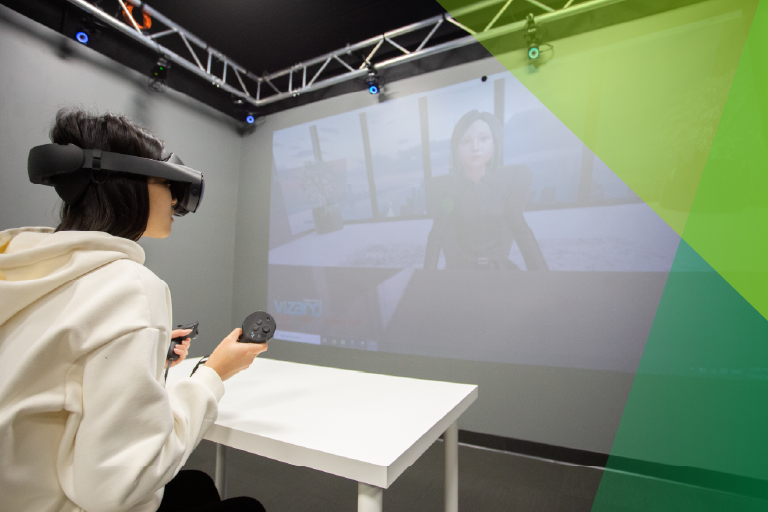
Standing on a virtual stage before a room full of digital eyes may feel artificial, but new research from the Department of Communication shows the body responds as if the experience is real.
In a recently published study in Scientific Reports, part of the Nature Portfolio, researchers examined how audience feedback in immersive virtual reality affects public speakers’ biological and behavioral responses. The project was led by Ralf Schmälzle and Gary Bente, professors in the Department of Communication and researchers in MSU’s Center for Avatar Research and Immersive Social Media Applications (CARISMALab), in collaboration with Sue Lim of Purdue University. The study was supported by the National Science Foundation (PI Schmälzle).
Using immersive virtual reality (VR), the team measured speakers’ physiological reactions, emotional response and communication behaviors in real time. Participants delivered speeches in front of digital audiences composed of avatars programmed to display either supportive or unsupportive feedback.
The researchers tracked heart rate, breathing patterns, voice and speech characteristics, as well as brain activity patterns. Motion-capture technology was used to analyze nonverbal expressiveness.
The findings reveal that those unsupportive digital agents — avatars designed to appear distracted or hostile — triggered significant spikes in anxiety and physiological stress. Speakers facing these negative cues not only reported greater discomfort, but also exhibited measurable biological changes. In some cases, their speaking rate slowed, suggesting that audience feedback loops, even in virtual settings, can meaningfully alter communication performance.
The results underscore the powerful role of social-evaluative threat — the fear of being judged — in shaping how people communicate. Even when the “audience” consists of computer-generated characters, the body responds as if the social stakes are real.
“In an era where AI-driven avatars and intelligent agents are about to explode across our digital landscape, mastering the ancient art of public speaking and responding appropriately to these communication feedback loops is absolutely essential,” Schmälzle said "Our research provides a blueprint for the metaverse, ensuring that next-generation virtual ecosystems are designed to foster effective social interaction.”
Beyond implications for virtual environments, the research points to broader applications for education, workplace training and public life. Schmälzle said immersive VR holds significant potential to both train and augment human communication skills — not only for digital spaces, but also for offline contexts where effective speaking remains critical in politics, business and education.
As AI-powered avatars and virtual environments become more common, the study highlights a central insight: In communication, perception and biology are tightly intertwined — even when the audience exists only in pixels.
By Claire Dippel