
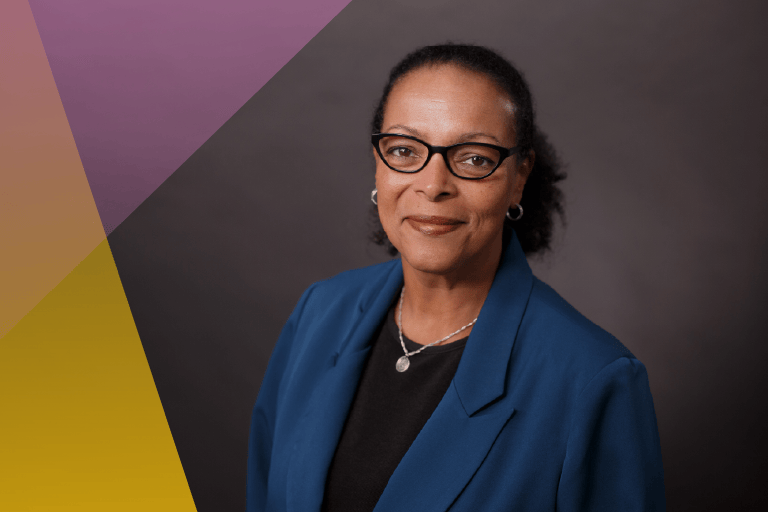
Susan McFarlane-Alvarez, a professor in the Department of Advertising and Public Relations, recently led an international workshop titled “The Scholarly Self: Research Visibility and Academic Storytelling, designed to help visiting scholars strengthen the visibility and broader impact of their research through strategic communication and storytelling.
The workshop brought together scholars from across the African continent who make up the fifth cohort of MSU’s African Futures Visiting Scholars Program. Participants represented a wide range of disciplines, and hailed from universities in Uganda, Kenya, Senegal, Botswana, Tanzania, South Africa and Nigeria. The session was sponsored by the Alliance for African Partnership and co-hosted by Jose Jackson-Malete, co-director of the alliance within MSU’s International Studies and Programs.
McFarlane-Alvarez, designed the workshop to help scholars articulate both the intrinsic and extrinsic value of their work and translate it for broader audiences.
“Using the tools of strategic communication, we guided scholars through defining or re-defining their scholarly identity and learning how to tell the story of their research in ways that resonate beyond academic circles,” McFarlane-Alvarez said. “That includes thinking intentionally about audiences, networks and the social impact their work can have.”
The workshop also highlighted ComArtSci’s distinctive expertise at the intersection of research and practice. Faculty in the college specialize in audience-centered research, message strategy and the transformation of complex ideas into compelling narratives that travel effectively through networks and communities.
“Communication Arts and Sciences is uniquely positioned to consider the interdisciplinary nature of communication,” McFarlane-Alvarez said. “From my perspective, the challenges that scholars face are mirrored in other forms of strategic and expressive forms of communication. Collectively, our theoretical lenses and creative practices can help scholars across disciplines and geographies ensure their research achieves the broadest possible impact.”
Building on this work, McFarlane-Alvarez recently received a PIRA Grant for a collaborative project with the University of Botswana. Through the grant, she is partnering with Dikabo Mogopodim Ph.D., an analytical chemist, fellow of the Africa Science Leadership Forum and deputy secretary general of the Botswana Academy of Science.
Together, they are designing a program to help early career scholars strengthen research impact through audience-centered communication, expanding on concepts of the scholarly self and pathways to research visibility introduced during the MSU workshop.