
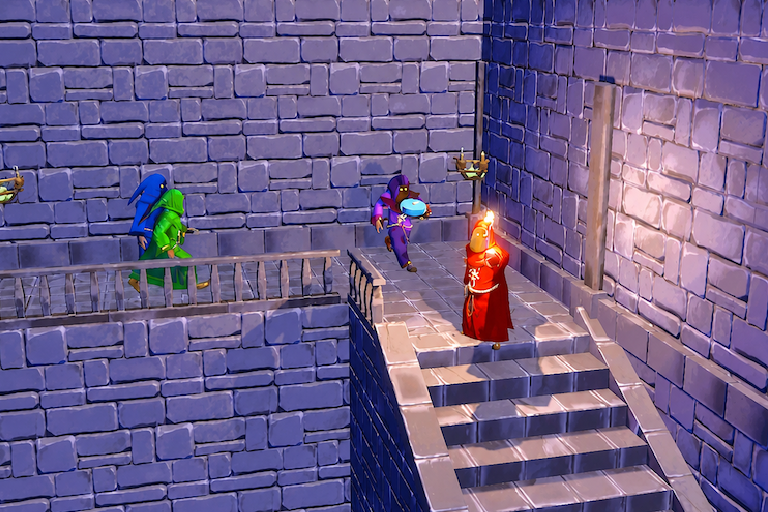
A team of students in the College of Communication Arts and Sciences recently earned second place at the 2026 Michigan Games Entrepreneurship Race with their original multiplayer fantasy game, “Dimlits.”
Created by junior student Austin Endres alongside Langston Key, Eric Zheng, Quinten Ruff, Vivek Kilari, Daniel Grover, Sydney Gossage and Chris Currier, “Dimlits” is a cooperative multiplayer game where players explore a dungeon, battle a shadow god and work together to restore light to the land. The student team collaborated across technical design, programming, 3D character and environment art, production and audio design to bring the game to life.
Hosted annually, the Michigan Games Entrepreneurship Race highlights emerging student and independent game developers from across the state, giving teams an opportunity to pitch and showcase original game concepts in front of industry professionals, judges and attendees from Michigan’s gaming and entrepreneurial communities.
For Endres, one of the most rewarding parts of the process has been seeing the team’s shared vision evolve into a fully realized world.
“I am most proud of the world that we are creating,” Endres said. “From designers making rooms for levels, artists making amazing models and textures for assets, programmers helping create interesting systems that players interact with, and audio designers crafting amazing sounds and music, we all work so hard on all the different parts of the game to make this world come to life.”
Throughout development, the team worked closely with Cory Heald, professor of practice in the Department of Media and Information, using classroom discussions and feedback sessions to troubleshoot design challenges and refine gameplay systems. Endres said those conversations helped the team navigate the game’s evolving creative direction while learning how collaborative development works in professional game studios.
The classroom environment also provided opportunities for regular playtesting, allowing students to gather direct feedback from classmates and faculty as development continued.
“Having a whole class and area where we can playtest Dimlits is super helpful because it lets us get direct feedback on what people think about our game,” Endres said.
The team said the experience of developing “Dimlits” closely mirrors the collaborative workflows used throughout the gaming industry, from iterative design and testing to large-scale team coordination. In addition to being showcased during the Department of Media and Information’s annual Game Development Showcase, the project’s recognition at the Michigan Games Entrepreneurship Race highlighted the team’s ability to combine creative storytelling with professional-level game production.
Students plan to continue developing “Dimlits” through future coursework and independent production efforts over the summer and into the next academic year.
“Making games in school is the same way people in the industry do it,” Endres said. “We all do the same thing — just the scale at which we do it might differ. We all love games though and that is why you choose this career path.”
By Claire Dippel