
For 30 years, the Knight Center for Environmental Journalism at Michigan State University has focused on one central mission: helping journalists understand and explain complex environmental issues to the public.
A national first in environmental journalism
The center was founded in 1994 when the John S. and James L. Knight Foundation created the nation’s first endowed chair in environmental journalism within MSU’s School of Journalism. It was established at a time when growing concerns about water pollution, air quality and habitat destruction demanded deeper, more consistent media coverage.
“The legacy is building the capacity of journalists to understand and explain complicated environmental issues to the wider public,” said Eric Freedman, director of the center and a professor in the School of Journalism. “That’s what we’ve been about from the start.”
Freedman joined the faculty early in the center’s history and became director in 2013. The Knight Center traces its roots to the creation of the nation’s first endowed chair in environmental journalism. Jim Detjen was recruited to fill that position, and under his leadership, the initiative grew beyond a single professorship to include research, multiple courses, student reporting projects and professional outreach. Detjen, a co-founder of the Society of Environmental Journalists, retired in 2011.
Connecting science, journalism and the Great Lakes
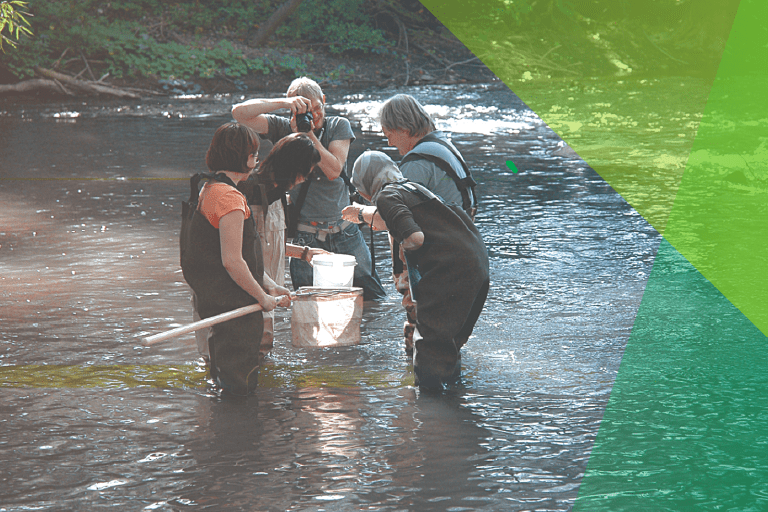
Over time, the center developed specialized classes, supported student reporting initiatives such as Great Lakes Echo and hosted workshops and conferences that connected journalists with scientists and policymakers. Its geographic focus has often centered on the Great Lakes basin, examining issues such as climate change’s effects on regional water levels, agricultural impacts and freshwater protection.
Preparing journalists for a changing media landscape
Environmental journalism itself has evolved dramatically over the past three decades. Local newsrooms have downsized, leaving fewer reporters dedicated to environmental beats, even as coverage of scientific research has grown more sophisticated and global.
“There’s much more coverage of scientific research, and we focus on that with our students,” Freedman said. “How do we take these academic studies and tell stories that the broader public are interested in?”
He also noted that environmental journalists increasingly face political pressure and personal risk for their work. Some of his own research examines the dangers journalists encounter when reporting on environmental issues that challenge powerful interests.
Students at the center of the mission
Despite changes in the media landscape, Freedman said the center’s proudest achievement is its students.
“It’s nice getting grants,” he said, “but sending students out equipped to cover the environment — or any complex issue — with strong analytic skills is what matters most.” Graduates have gone on to work in newsrooms, nonprofits and classrooms around the world, often becoming educators and mentors themselves.
For longtime administrative assistant Barb Miller, the center’s impact is also reflected in its academic growth.
“Our legacy is expanding the research capacity for both our faculty and our students,” Miller said. “Our students are our greatest source of pride. They arrive eager to learn, and through their reporting and research, they become informed and engaged in the environmental issues they cover.”
Celebrating 30 years
As the center celebrates its 30th anniversary, it marks the milestone with public programming, including co-sponsoring the 2026 Neal Shine Ethics Lecture featuring Susan Goldberg on March 10, additional lectures in the fall, an alumni panel and the reburial of a time capsule.
Three decades after its founding, the Knight Center continues to expand research opportunities for faculty and students while maintaining its hands-on approach — ensuring the next generation of journalists is prepared to cover some of the most pressing issues of our time.
By Claire Dippel