
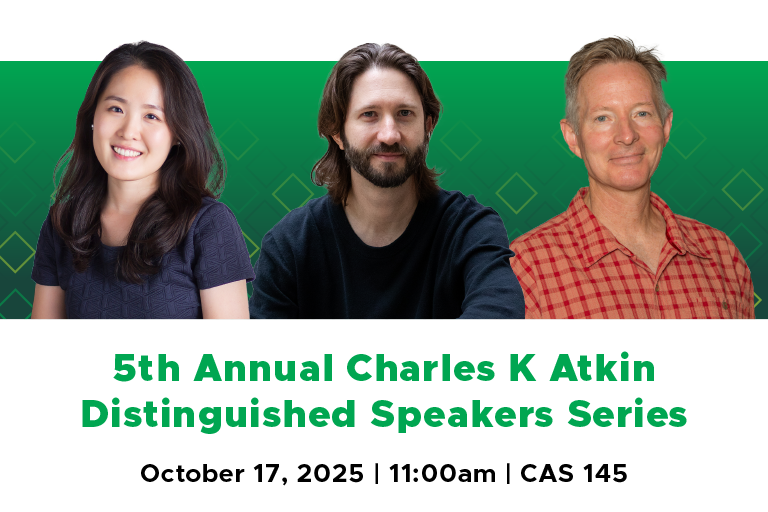
Join us for the 5th Annual Charles K. Atkin Distinguished Speakers Series
Hosted by the Department of Communication
We are excited to welcome three distinguished scholars for this year's series. Please join us for a day of thought-provoking talks and engaging discussion.
11:00 a.m. | Soo Yun Shin, Seoul National University
Can AI-MC Help Us Achieve More Civil and Positive Online Discussion?
Abstract: Incivility has long been a persistent challenge in online discussions. While anonymity enables open dialogue on sensitive topics, it also makes toxic exchanges more likely. Traditional moderation relies on human reviewers, and newer approaches increasingly employ AI algorithms—but these raise concerns about censorship. This talk examines how AI-mediated communication (AI-MC) can instead serve as an encourager, guiding participants to voluntarily revise their messages. Drawing on experimental studies, it highlights AI-MC’s potential to reduce conflict and promote more constructive engagement.
Bio: Soo Yun Shin is an Associate Professor in the Department of Communication at Seoul National University. She conducts experimental research on computer-mediated and interpersonal communication, with recent projects examining how AI-mediated communication can reduce online conflict. She received her Ph.D. from Michigan State University and previously taught at the University of Hawai‘i at Mānoa. Her work has been published in leading journals such as Communication Research, Journal of Computer-Mediated Communication, Communication Monographs, and Media Psychology. She serves on the editorial boards of Human Communication Research and the Journal of Computer-Mediated Communication, and has received top paper awards from ICA and NCA. Her latest research was supported by a grant from Samsung Electronics.
1:30 p.m. | Matthew Grizzard, The Ohio State University
Stories, Characters, and Morality: Mid-career Reflections on a Program of Research
Abstract: Storytelling is central to the human experience. Affective Disposition Theory (ADT) offers a parsimonious explanation of how audiences come to root for or against characters, as well as anticipate and evaluate narrative events. This talk provides a mid-career reflection on a sustained program of research and considers what comes next. Looking back, I will highlight results from a comprehensive, preregistered study that models ADT’s core processes through a series of experimental inductions and path analyses. I will then turn to more recent studies that provide insights for incrementally refining ADT’s theoretical precision. These studies validate a measure of character depth, examine interdependent character evaluations, show how backstories bias audience judgments, and document schematic perceptions beyond heroes and villains. Looking forward, I will discuss how continued programmatic, theory-driven research can advance our understanding of storytelling—and general principles of social interaction—one small study at a time.
Bio: Matthew Grizzard (PhD, Michigan State University, 2013) is a Scarlet and Gray Associate Professor in the School of Communication at The Ohio State University. His research lies at the intersection of media psychology and mass communication, focusing on how people make moral judgments when engaging with popular media, particularly narratives. He investigates how audiences morally evaluate characters; how these judgments are relative and shaped by narrative context; and how such processes help explain real-world phenomena such as polarization and Schadenfreude. He is an Associate Editor of Journal of Media Psychology and serves on the editorial boards of Human Communication Research, Media Psychology, Psychology of Popular Media, and Communication Research Reports. He has previously served in leadership roles within the Communication and Social Cognition Division of the National Communication Association.
3:00 p.m. | Jim Dearing, Michigan State University
On Career (A Summing Up): Sociological Concepts Through Experiences of Mine
Abstract: In this career retrospective I will discuss the ideas of serendipity, learned professionalism, professional humility, cumulative advantage, and authority-information deficit through several stories. My first academic talk at Michigan State was a bit of a muddle. This one, hopefully less so. The career choice of being an academician demands careful consideration at this time in our country. Should you, or shouldn't you? Here's what's worked for me.
Bio: Jim Dearing (Ph.D., University of Southern California) is Brandt Endowed Professor at Michigan State University in the United States. Dearing studies the diffusion of innovations, including the adoption and implementation of new evidence-based practices, programs, technologies, and policies. He studied under and collaborated with Everett M. Rogers for 20 years. He has led and worked with research and practice improvement teams for innovations in toxic waste remediation, nursing care, injury and fatality prevention, maternal and child health, environmental policy, HIV/AIDS prevention, and science education. He has been principal investigator for grants from the Robert Wood Johnson Foundation, the Wallace Foundation, W.K. Kellogg Foundation, John D. and Catherine T. MacArthur Foundation, the Bill & Melinda Gates Foundation, and U.S. federal agencies including the National Cancer Institute and the National Science Foundation. Jim is a fellow of the International Communication Association and was a member of the Board of Scientific Counselors of the U.S. Environmental Protection Agency. Currently, Dearing works with the U.S. Centers for Disease Control and Prevention to design and launch the Adoption Accelerator to speed the adoption of drug overdose prevention technologies and practices.