
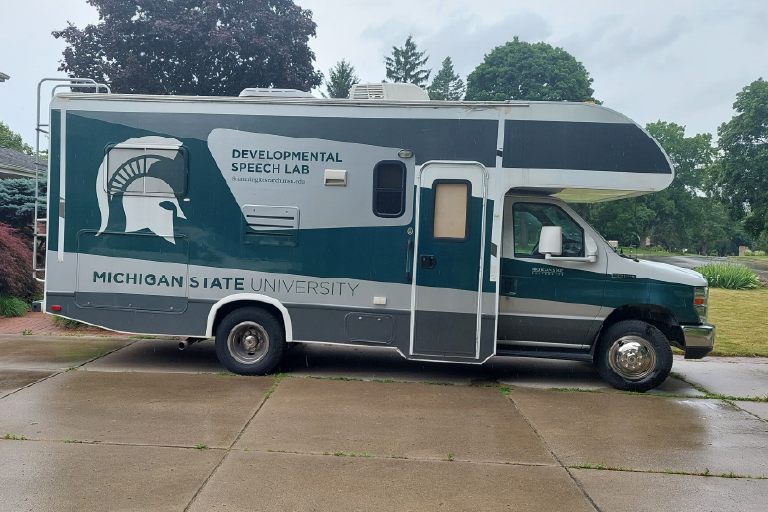
This summer, Michigan State University researchers traveled more than 1,000 miles across Michigan to study how amplification devices, paired with speech strategies, can make communication louder, clearer and easier for people with Parkinson’s disease and related conditions.
Thea Knowles, an assistant professor in the Department of Communicative Sciences and Disorders (CSD), studies communication challenges associated with Parkinson’s disease and atypical parkinsonism. With support from the National Institutes of Health and CurePSP, her team is examining how portable speech amplification devices and behavioral speaking strategies can improve everyday communication while potentially reducing the burden of treatment.
Parkinson’s disease can make it difficult for people to project their voices and be understood. Traditional treatment often teaches people to adjust how they speak, while amplification devices make their voices louder with less effort. The research could help clinicians better understand how the approaches work together and how communication support can reflect each person’s needs and experiences.
Participants completed speech tasks, conversations and games while using different combinations of amplification and speaking strategies. Researchers analyzed the physical properties of their speech, including its volume and clarity, as well as how much listeners understood and how much effort it took to understand them. The team also gathered participants’ perspectives on the devices and strategies to better understand how they might work in daily life.
Taking the lab to participants
Until June, participants had to travel to the Speech Outcomes in Neurogenic Communication, or SONiC, Lab in East Lansing. For older adults managing Parkinson’s symptoms, other health limitations and frequent medical appointments, that trip could be difficult. Some also depended on family members to provide transportation.
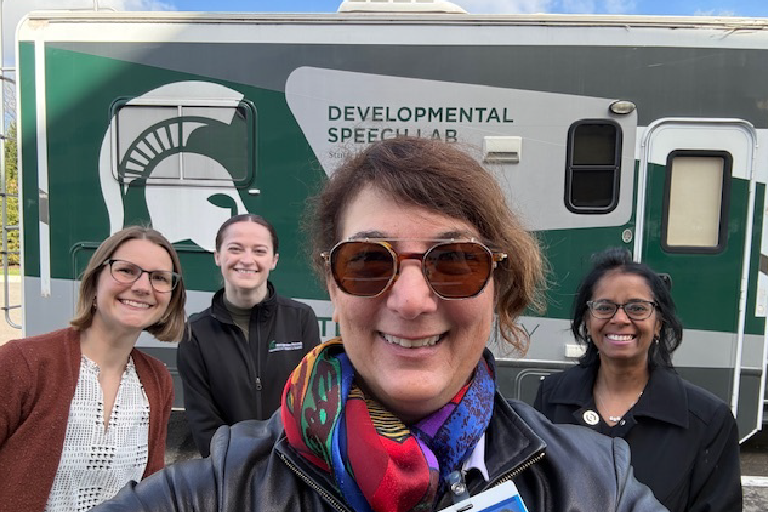
Taking the study on the road accelerated recruitment and allowed the team to reach people from farther across Michigan who might otherwise have been unable to participate. During the summer, the team collected approximately as much data as it had during the previous year in the campus lab.
The SONiC Lab’s sound booth provides the controlled recording environment necessary to compare speech samples. Homes, clinics and community centers may be more convenient for participants, but their different acoustics can affect the consistency of recordings. The mobile lab provided a more standardized space that could travel to participants.
The mobile lab is part of Bridget Walsh’s Developmental Speech Lab. Walsh, an associate professor in CSD, developed the lab on wheels to bring research on childhood stuttering to children and families who faced barriers traveling to campus.
Other researchers in the department have since used the vehicle to expand the reach of their work. This summer, Jeff Searl, a professor and associate chair of CSD, and doctoral student Busra Ensar-Yilmaz also used it to collect data across Michigan for Ensar-Yilmaz’s dissertation research, demonstrating how the shared resource is creating new research opportunities.
Taking the Parkinson’s research across the state required coordination among MSU, Henry Ford Health and other clinical and community partners. Maura Philippone, a doctoral candidate in CSD and the study’s project coordinator, helped manage participant recruitment and scheduling, prepare study materials, administer research protocols and supervise undergraduate researchers.
“The mobile lab significantly expanded access to our study by allowing us to meet participants closer to where they live, reducing transportation and logistical barriers that might otherwise impede participation,” Philippone said.
Learning from participants and communities
The mobile lab also gave graduate and undergraduate students experience conducting research in communities and learning directly from people with Parkinson’s disease and their communication partners.
At a hospital in West Bloomfield, Ava Kardynal, a senior majoring in communicative sciences and disorders and an undergraduate research assistant in the SONiC Lab, helped prepare the mobile lab and served as a communication partner for participants.
Rachel Chomas, a junior majoring in communicative sciences and disorders and an undergraduate research assistant in the lab, helped administer cognitive and hearing screenings. She frequently heard about communication difficulties in couples when one partner had a softer voice because of Parkinson’s disease and the other experienced hearing loss.
Those conversations placed the research in the context of participants’ relationships, routines and identities. Kardynal recalled a participant who was saddened that changes associated with Parkinson’s disease had made it impossible to continue singing in a choir.
“It was a very emotional moment and another reminder of how much Parkinson’s disease takes away from people,” Kardynal said.
For Philippone, participants and their communication partners provided insight into the challenges they experience, the approaches they find helpful and the resources that could better meet their needs.
“Connecting directly with people and learning about their experiences is one of my favorite parts of being a researcher,” Philippone said. “It’s even more rewarding to connect people’s lived experiences with what we currently know from research to create more person- and community-centered communication supports.”
The mobile lab also built on the SONiC Lab’s relationships with Parkinson’s organizations and support groups. In Jackson, participants visited the lab outside a YMCA, and the team joined support group meetings to discuss communication changes and speech-language pathology services.
Chomas said the experience strengthened her desire to become a speech-language pathologist and showed her the importance of community.
“All the members feel like family, and they are able to laugh and have fun with one another while experiencing a difficult period in their life,” she said.
For Knowles, pairing research with education helps make the relationship with communities reciprocal. Although participating in a study may not immediately change someone’s daily life, the lab can provide information and resources while learning from community members’ experiences.
“It’s a give and take,” Knowles said. “We’re able to provide something for folks beyond just participating in research.”
The experience also reinforced for Kardynal what is at stake when someone’s ability to speak changes.
“Communication is truly a human right,” she said. “To help someone regain that ability is such a gift.”
By Claire Dippel