
During an afternoon with people who had undergone laryngectomies, Michigan State University student Isabel Pascua heard one participant describe how a speech-language pathologist helped him speak with his family again.
That participant was among the members of the Shout at Cancer Laryngectomy Choir who met with students in London. A laryngectomy is surgery to remove the larynx, or voice box. After singing together, the students gathered in small groups to hear choir members' stories and ask questions about their lives after the procedure.
One man told the students that his speech-language pathologist, or SLP, had saved his life. For Pascua, a fourth-year student majoring in communicative sciences and disorders, the conversation changed how she viewed her future profession.
“This moment helped me realize that SLPs do way more than just help individuals with their speech therapy,” Pascua said.
The afternoon ended with a last-minute decision to teach the choir the “MSU Fight Song.” The students found a recording with lyrics on YouTube, then sang and danced with the group.
The program at 40
Pascua was one of 15 students who participated in Communication Disorders in the UK, the education abroad program offered by MSU's Department of Communicative Sciences and Disorders, or CSD, in 2026.
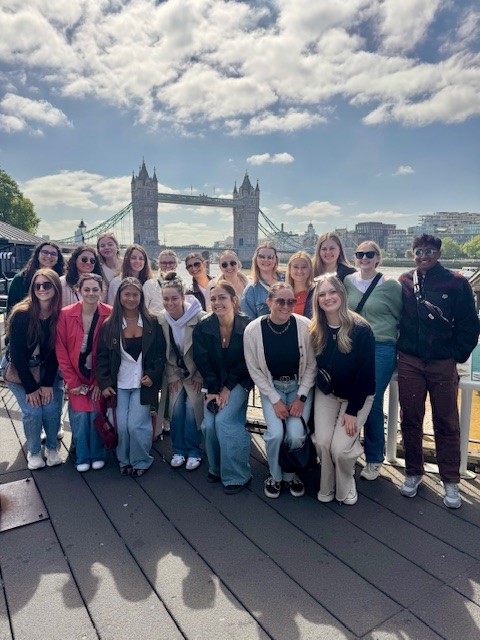
2026 cohort in front of the London Bridge.
Now marking its 40th program year, Communication Disorders in the UK has taken 727 participants from 30 universities abroad since 1985. The program paused in 2020 and 2021 during the COVID-19 pandemic.
Jeff Searl is a professor in CSD, associate chair of the department and director of the Lip-Tongue-Larynx Lab, which studies how cancer and other diseases affect speech, voice and swallowing. As the current director of Communication Disorders in the UK, he led the 2026 cohort.
The program combines lectures from clinicians and researchers with visits to hospitals, schools and support groups. Students see how speech-language pathology and audiology operate within another country's health care, education and social support systems.
Paul Cooke, associate professor emeritus in CSD, whose work directing the program spanned more than 30 years, said faculty prepare students for visits and lead discussions afterward, helping them connect what they observe with what they have learned at MSU.
“You're not learning about someone from a book. You're sitting with them as they share their life story,” Cooke said.
Learning that changes careers
For years, one visit has taken students to the Doncaster Stammering Association to speak with adults who stutter. Brittany Oakley (Johnson), who participated in 2017, remembers meeting a woman in her 60s who had only recently walked into a cafe and placed an order in person for the first time.
Oakley compared the story with the nervousness she sometimes felt raising her hand in school. She was struck by the woman's willingness to share it with students.
“I learned that each person does what they need to do at their own pace,” Oakley said.
Oakley also visited Laycock Primary School, where children who were deaf or hard of hearing learned alongside their peers. She remembers a supportive classroom atmosphere and hearing children with cochlear implants speak fluently and even sing for the visitors.
The trip influenced Oakley's career. After earning a bachelor's degree in communication with a minor in communicative sciences and disorders, she completed MSU's master's program in speech-language pathology. She is now a speech-language pathologist with Henry Ford Home Health Care in Detroit.
Ariana Farhad, graduate program director for CSD and a certified speech-language pathologist specializing in the evaluation and treatment of children with hearing loss, found similar clarity during the 2011 program. A visit to Laycock Primary School and a meeting with a cochlear implant team helped Farhad identify her interest in hearing and early intervention.
“That was the moment it clicked,” Farhad said. “I knew I would be working with deaf and hard of hearing kids the rest of my career.”
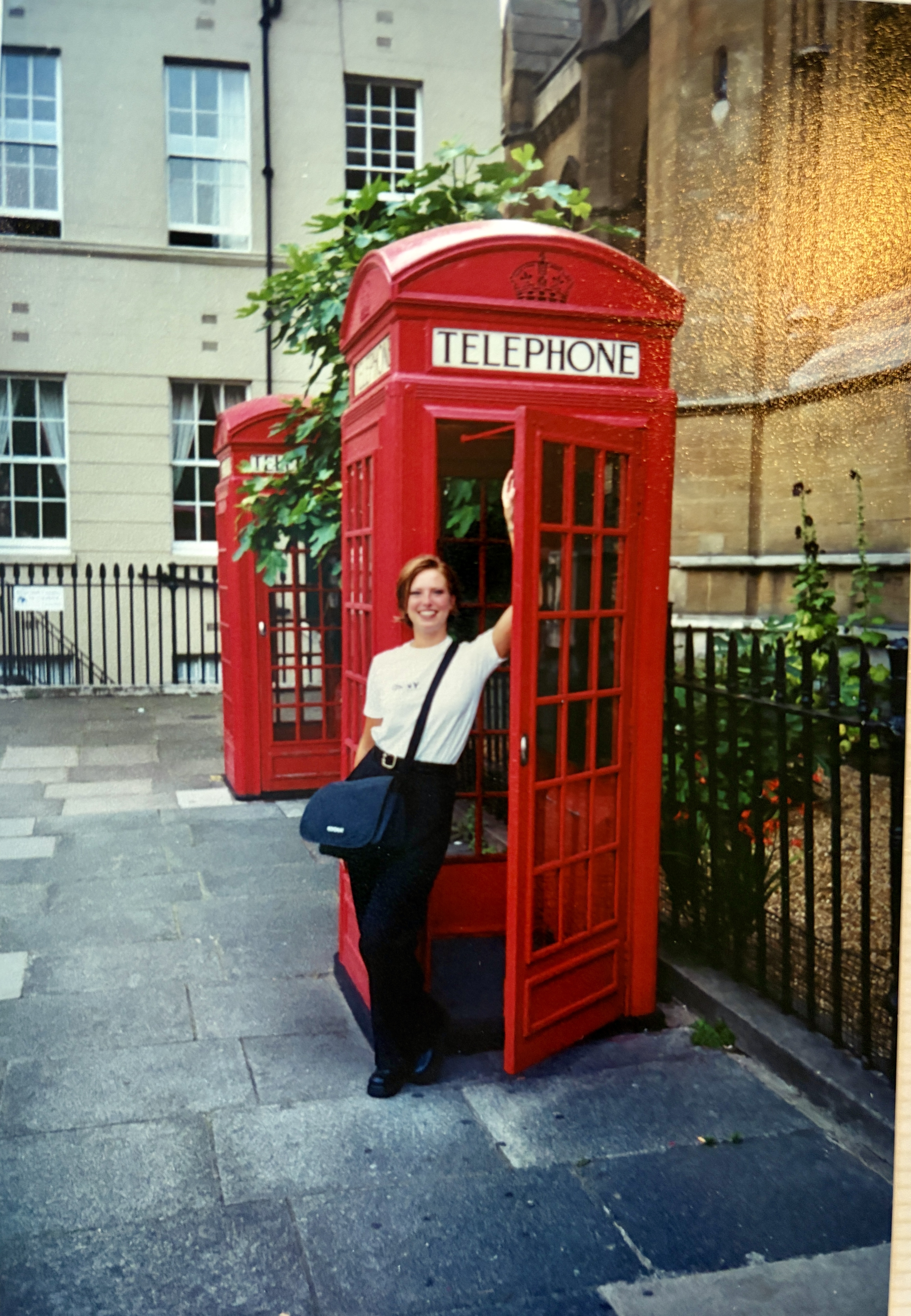
Marnie Rossow during her 1999 trip in front of a London phone booth.
Marnie Rossow, who participated as a CSD undergraduate in 1999, remembers encountering electropalatography, a technique that provides visual feedback about tongue placement during speech. Rossow went on to practice speech-language pathology for 25 years in hospitals, public schools and an ear, nose and throat office.
The program today
In 2026, students learned from clinicians and researchers at University College London, the Royal National ENT and Eastman Dental Hospital and the National Hospital for Neurology and Neurosurgery. They met with support groups focused on stuttering, aphasia and head and neck cancer.
Cultural activities included visiting York, attending a West End performance of “Six” and having afternoon tea at Kensington Palace.
Searl said the program gives students access to clinicians and researchers in small-group settings while showing them how their profession is practiced within a different cultural, political and educational environment.
“Building meaningful relationships with my future clients is just as important as helping them through communication challenges,” Pascua said. “This opportunity added to my passion to become an SLP and reminded me that it is so much more than therapy.”
Four decades of faculty commitment
Communication Disorders in the UK grew from international relationships developed by Leo Deal, a longtime professor of audiology and speech sciences and department chairperson. At the time, CSD was known as the Department of Audiology and Speech Sciences, a name it retained until 2006.
After connecting with speech-language pathology professionals in England, Deal explored an exchange between MSU and British students. Differences in academic calendars, curricula and finances prevented a two-way exchange, but Deal's relationships led to the creation of the education abroad program.
Leadership has since passed from one faculty director to the next. Peter LaPine, a CSD professor emeritus and former program director, learned alongside Deal before directing trips through 2013. Cooke first directed the program in 1986 and made his final trip in 2025. Cooke and LaPine overlapped in London as they transferred responsibilities. Searl later accompanied Cooke during portions of three programs before assuming leadership himself.
When asked what kept him returning for so many years, Cooke became emotional. He spoke about watching students' worldviews expand and seeing their “aha moments,” sometimes during informal conversations and unexpected experiences that were not part of a course objective. Witnessing those changes, he said, was a highlight of his career.
“The program can change lives in three to five weeks,” Cooke said. “We don't get many chances to be involved in something that is bigger than ourselves. That's pretty special.”
Creating those experiences requires substantial faculty work. Directors recruit students, maintain relationships with international partners, develop the itinerary, prepare participants and manage logistics — often before knowing whether enough students will enroll for the trip to proceed.
“It's an 11- or 12-month commitment,” Cooke said.
Once students enroll, the work becomes personal. Directors support students through what may be their first flight, first international trip or first extended time away from family. They meet students when they arrive, help them adjust and remain responsible for their learning and well-being throughout the program.
Following the pandemic pause, the program changed from more than five weeks and six credits to three weeks and three credits. Its locations within the UK and its professional partnerships have also changed as directors developed new connections.
More than an education abroad program
Students arrive with a shared interest in communicative sciences and disorders and many of the same professional goals. Abroad, they attend academic activities together, but they also share meals, navigate public transportation and solve problems when plans change.
“This kind of trip bonds you together with these shared experiences,” Oakley said.
Oakley remembers witnessing people regain their ability to communicate, getting lost in London, rushing to catch the Tube and sharing jokes that followed the group home. She remains close with members of her cohort and formed lasting friendships with LaPine, Cooke and Cooke's wife, whom she later invited to her wedding.
Rossow's 1999 cohort remains connected through an active Facebook message group. Rossow also remained friends with Cooke and LaPine.
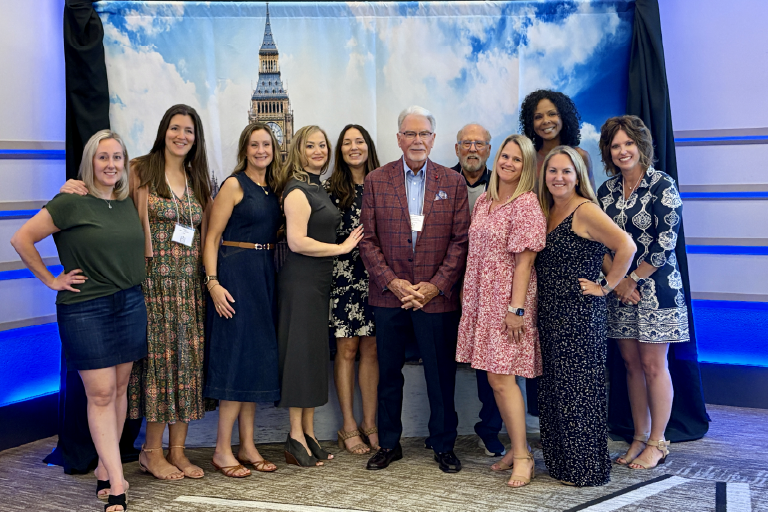
Alumni of the program standing with former program directors, Peter Lapine and Paul Cooke.
Farhad remains in touch with members of her cohort and now encourages current students to consider education abroad for the perspective it provides.
“It's not just about how cool it is to stand by Big Ben, but to understand the world doesn't revolve the way yours does for everybody,” Farhad said.
She believes that understanding helps students develop what she calls “more active empathy” for clients and families whose experiences differ from their own.
Faculty relationships also endure. LaPine still receives Christmas cards from former participants. He said completing the experience leaves students with a lasting belief in their abilities.
“It sort of has an imprint on people that, ‘Hey, I can do that. And I did that,'” LaPine said.
Celebrating 40 years
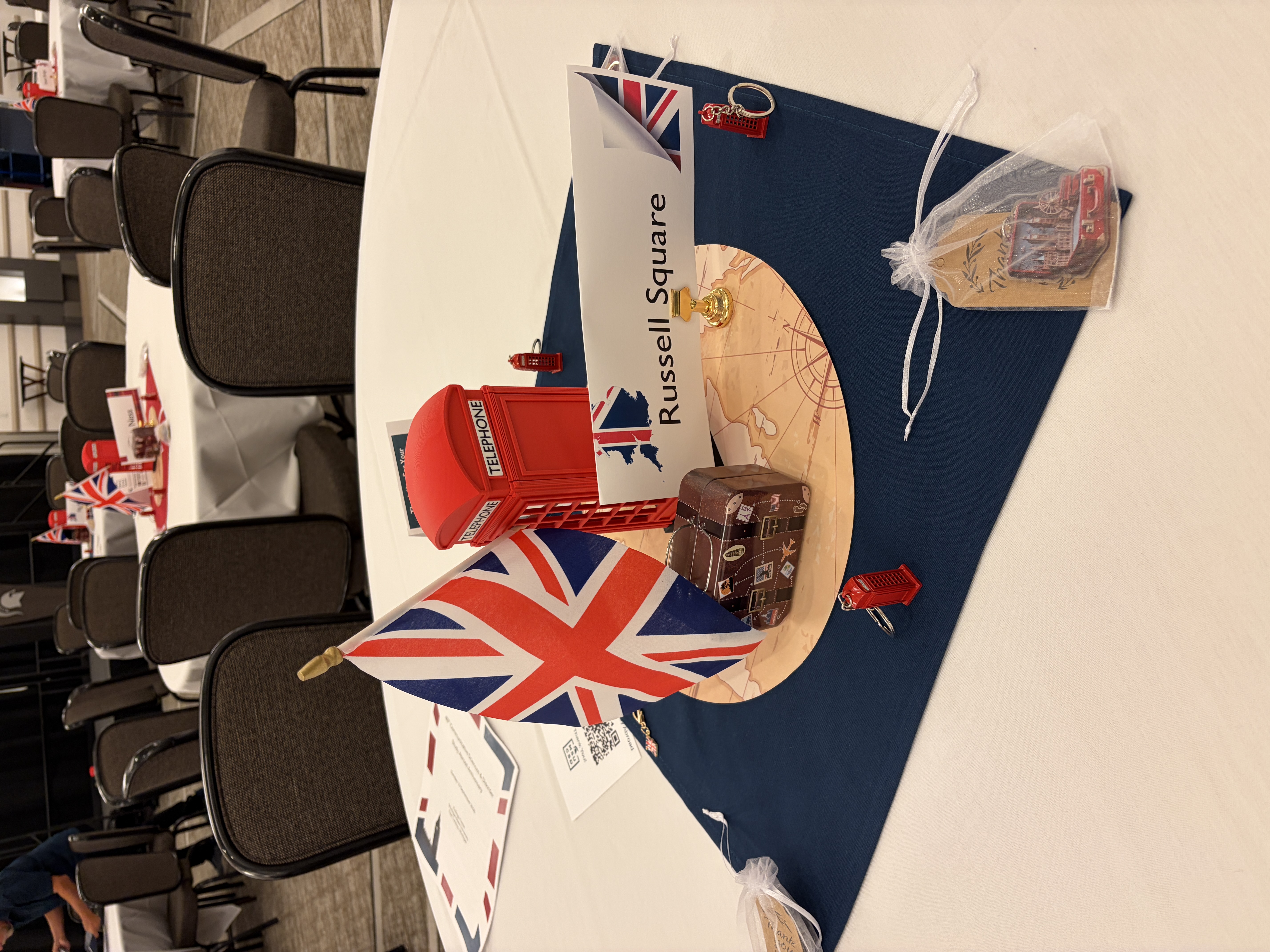
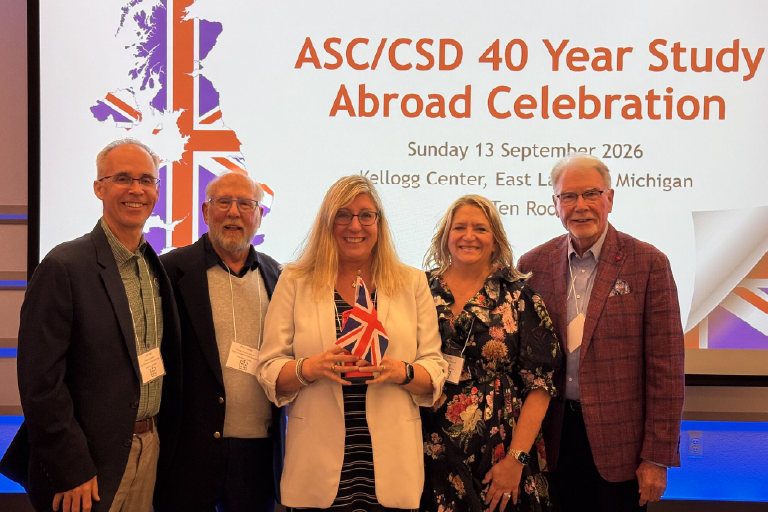
The program's anniversary brought alumni, faculty, staff and supporters to the Centennial Rooms at the Kellogg Hotel & Conference Center on Sept. 13. Program directors from across its history joined current and former CSD faculty members.
Guests reconnected with former classmates and faculty, viewed photos from four decades of trips, shared stories from their time abroad and reflected on the program's influence on students, alumni and the profession.
Cooke led the planning committee, which included former program directors, alumni, MSU Education Abroad staff and ComArtSci advisers and staff. Searl, LaPine, Oakley, Rossow and Farhad were among its members.
During her 2017 trip, Oakley created a video documenting the places the group visited and the friendships its members formed. Cooke continued showing it to prospective participants, and it was screened during the celebration.
Looking ahead
Elizabeth Wandschneider, senior assistant director for Global Learning Programs at MSU, said sustained faculty involvement and the program's specialized academic focus have contributed to its longevity. She said it is unusual for a specialized, faculty-directed program to continue for four decades.
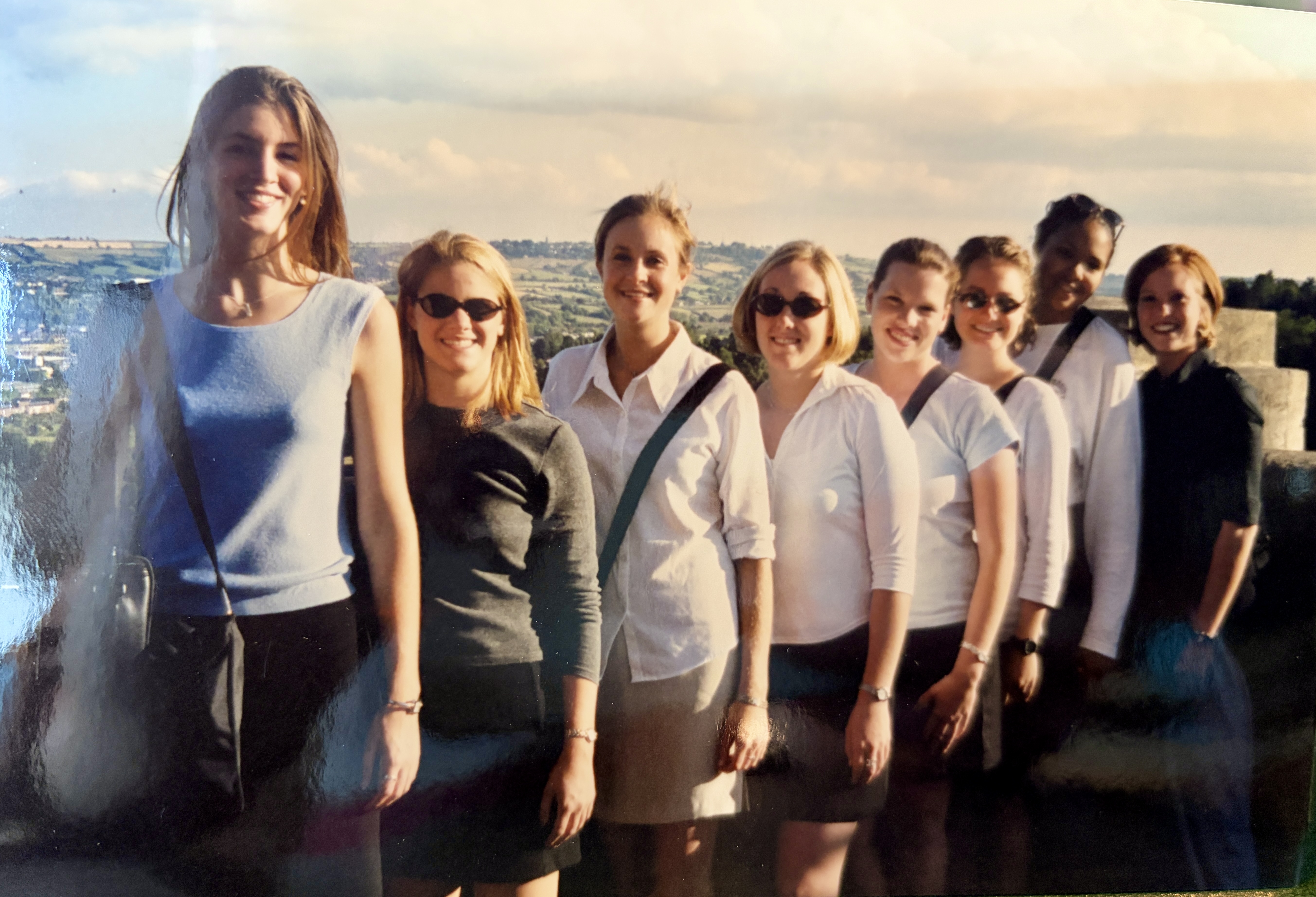
Women from the 1999 cohort during their program trip.
The Leo Deal Endowment helps extend those opportunities to future students. The endowment was established in 1994 after Deal's retirement from MSU to help students and faculty broaden their perspectives and exchange ideas with colleagues around the world.
Awards often support students participating in Communication Disorders in the UK, along with international exchanges, conferences and visits by international speakers and researchers.
Now back on campus, Pascua remains close with members of the 2026 cohort and plans to pursue graduate school to become a speech-language pathologist. She expects to remember the friendships she formed and the experience of living in a new place while studying a subject she cares about.
“This experience was such a highlight of my college experience and my time at MSU,” Pascua said. “I'm so thankful my peers and I are now forever part of this.”
By Claire Dippel